Back to School Label Book Animal Turtle: A Practical Digital Asset for Organised Creative Workflows
Preparing for the back-to-school season involves a great deal of planning, organising, and creative execution. Parents, educators, small business owners, and content creators all face the same challenge: how to produce consistently appealing labels and decorative elements without spending hours designing from scratch. The Back to School Label Book Animal Turtle digital product offers a structured yet flexible solution. With its assortment of animal turtle motifs in a label book format, this asset can streamline your workflow whether you are preparing classroom materials, creating product packaging, designing planners, or building social media assets.
Understanding the Asset and Its Delivery Format
The Back to School Label Book Animal Turtle is delivered as a comprehensive file set including AI, EPS, SVG, DXF, JPG, and PNG formats, each sized at 1920 by 1280 pixels. This range of vector and raster formats ensures that the design can move seamlessly between different software environments and production pipelines. The AI and EPS files preserve full editability for vector-based work, while SVG and DXF support compatibility with cutting machines and web platforms. The JPG and PNG versions provide ready-to-use raster options for quick placement or previewing.
Having all six formats means that a single purchase provides flexibility across multiple stages of a project. You can begin by editing the vector version in Adobe Illustrator or Affinity Designer, then export a PNG for use in Canva or PowerPoint, and later use the DXF for a physical vinyl cut or laser engraving. This kind of format coverage removes the friction of conversion and lets you focus on the creative and organisational tasks at hand.
Where the Asset Fits in a Broader Workflow
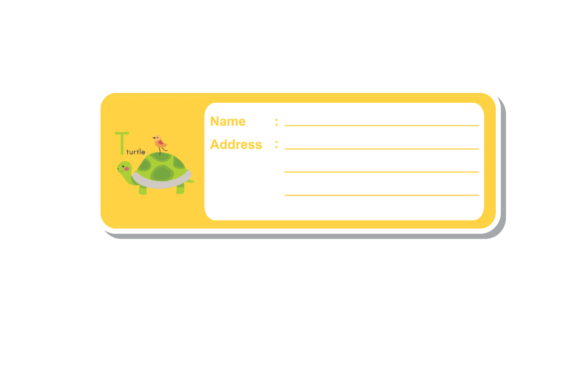
The Back to School Label Book Animal Turtle is most useful when considered as a modular building block within a larger production system. Whether you are a teacher creating name tags for a classroom, a small business owner labelling product bundles, or a content creator designing printable planners, the asset works best when integrated into a repeatable process.
Before starting a project, you can decide how the turtle label art will interact with your existing templates. For instance, if you maintain a set of master label templates in Adobe Illustrator, you can open the AI file and replace placeholder graphics with the animal turtle design. This preparation step ensures brand consistency and saves time later. If you work with cutting machinery for physical labels, importing the SVG or DXF into your cutting software before the production run allows you to test scale, orientation, and nesting in advance.
During a project, the asset can serve as a central visual theme. Imagine a classroom setup where every bin, folder, and stationery item needs a consistent animal turtle theme. You can generate multiple colour variants from the vector file, adjust the size for different label dimensions, and output both a digital version for Seesaw or Google Classroom and a printable version for laminating. The 1920 x 1280 pixel canvas gives you enough resolution for sharp prints up to A5 size while remaining lightweight enough for fast rendering in browser-based tools.
After a project is completed, the asset remains useful for future iterations. Because the files are fully editable, you can quickly return to the AI source, change a colour palette or add a new text field, and produce an updated set of labels for the next term or event. This reuse potential is especially valuable for educators and entrepreneurs who run recurring seasonal cycles.
Practical Implementation Tips for Different Users
Professionals working in print production will appreciate the consistency of the vector formats. When you open the EPS file, check that all strokes are expanded and that the turtle artwork is built with clean curves. This minimises issues during RIP processing and ensures crisp output on label stock. If you plan to use the design on adhesive paper, consider creating a bleed version by scaling the artwork slightly larger than your final trim size. The original canvas dimensions give you a good starting point for proportional scaling.
For educators and classroom organisers, the PNG and JPG files are the most straightforward entry points. You can drag the image directly into Word, PowerPoint, or Google Slides and layer it with text boxes for student names or subject categories. Because the canvas is horizontal, it works well as a top label for a folder or a front-facing tag on a cubby. If you need a circular or oval label, you can place the turtle design inside a clipped shape using basic software tools. The key is to keep the turtle centred so that cropping removes minimal detail.
Small business owners who sell physical label kits or printable digital products can use the DXF and SVG formats to create kiss-cut sticker sheets. Import the SVG into your cutting software, align it with your media dimensions, and run a test cut on plain paper before committing to vinyl or sticker stock. The animal turtle theme has broad appeal for children’s products, stationery bundles, and back-to-school promotions. You can also offer variations such as monochrome, pastel, or full colour by editing the vector source.
Bloggers and content creators covering organisation or parenting topics can use the asset to produce visual content for articles or social media. A before-and-after example of a labelled school binder featuring the turtle design makes for an engaging post. The raster files are ready to insert directly into blog images, and the vector files allow you to pull out individual turtle motifs for use as icons or bullet points in your design system.
Integration with Other Tools and Resources
The Back to School Label Book Animal Turtle works well alongside common design and office software. Adobe Illustrator users can open the AI file directly, while Affinity Designer, Inkscape, and CorelDRAW users can rely on the EPS fallback. For web-based workflows, the SVG file renders natively in HTML, making it possible to embed the design into a labelling app or an online ticket generator. The PNG file with a transparent background is ideal for layering in Canva, PicMonkey, or Photopea.
If you use a label printing service such as Avery Design & Print, you can upload the JPG or PNG into their template system. The 1920 x 1280 size aligns well with common label sheet layouts, especially when you match the resolution to the template grid. For DXF users working with Silhouette Studio or LightBurn, the clean geometry of the turtle outline ensures smooth cutting paths. In most cases, you can import the file, group the elements, and then resize proportionally without losing detail.
For those who manage multiple projects, organising the asset files by format in a dedicated folder structure improves retrieval speed. Consider naming conventions that include the design theme, format, and date, such as turtle_label_book_ai_v1. This small organisational habit pays off when you need to locate the source file months later for a repeat order or a derivative project.
Efficiency, Consistency, and Quality Control
The real value of a bundled format set is the elimination of conversion errors. When you work with a single provider that supplies all common format types in one package, you avoid the risk of losing stroke weight, colour profiles, or alignment during conversion. Before using the asset in a high-volume print run or a customer-facing product, run a quality check by opening the EPS in two different applications and comparing the rendering. Similarly, test the SVG in a browser and in your cutting software to confirm that the turtle shape remains intact.
Consistency across a series of labels is easier to maintain when you start from a master file. If you are producing labels for an entire classroom or a product line, open the AI file and use symbols or library features to instance the turtle art across multiple artboards. Any edit to the master symbol updates all instances automatically. This workflow reduces the chance of small variations that can make a set of labels look mismatched.
From a long-term use perspective, the asset continues to be relevant even as your software versions change. Vector formats such as EPS and SVG are widely supported and unlikely to become obsolete. Storing the original AI file alongside the exported versions gives you the highest degree of future flexibility. If you later adopt a new design tool, the SVG or EPS can serve as the migration format.
Planning Your Workflow for Maximum Impact
To integrate the Back to School Label Book Animal Turtle smoothly into your routine, start by defining the purpose of the labels. Whether they are for organisation, decoration, or identification, knowing the use case helps you choose the right format. For instance, if you need physical labels for a school open house, the DXF or SVG format paired with a cutting machine yields the fastest turnaround. If you are producing digital worksheets, the PNG file with transparency is the most direct choice.
Next, create a simple checklist of steps: inspect the files, select a format, edit colours or text if needed, test a sample, and then produce in bulk. By treating the asset as a component in a repeatable process rather than a one-off graphic, you build efficiency into your workflow. Over time, you may develop a set of customised templates that reference the turtle art, allowing you to generate new labels in minutes rather than hours.
Consider also how the asset interacts with team workflows. If you collaborate with a teaching assistant, a print shop, or a freelance designer, sharing the SVG or AI file ensures that everyone works from the same source material. Set basic guidelines such as preserving the original canvas ratio and avoiding raster effects on vector objects. Clear communication around file usage prevents rework and maintains quality.
The Back to School Label Book Animal Turtle is not just a decorative element—it is a practical component of a well-planned organisational or creative system. By understanding its format set, its role in various production stages, and its compatibility with common tools, you can deploy it with confidence across multiple projects, terms, and seasons. The result is a more efficient, consistent, and visually appealing labelling workflow that saves time and reduces stress during busy periods.